Of note, these stamps had to be purchased with specie, which as mentioned above, was hard to come by in the colonies. Due to the heavy burden the act would place upon merchants, trade documents, and legal documents, the act was universally hated in the colonies and even protested in England as well. Merchants, like John Hancock, threatened to halt trade with London until the act was repealed.
In a letter dates October 14, 1765, Hancock would write:
“Our trade here will entirely stagnate for it is the united Resolution & Determination of the people here not to carry on business under a Stamp. . . and nothing but the repeal of the act can retrieve our trade again. . . This letter I propose to. . . remain as a standing monument. . . that I by no means consented to a submission of this cruel act and that my best Representations were not want in the matter.”
Public frustrations over the passage of the Stamp Act boiled over in the summer of 1765. At the insistence of many politically-active merchants and the street gangs of Boston, citizens gathered around the Liberty Tree, on the corner of Essex and Orange Street. They began a vocal, riotous, celebratory, often-violent, and symbolic protest against the Stamp Act.
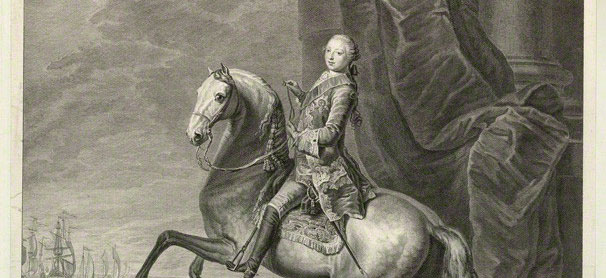
A scarecrow-like effigy of Andrew Oliver, the colony’s crown-appointed secretary/distributor of the stamps, was found hanging from the Liberty Tree. It was later “stamped” upon, beheaded, and burned. A second effigy in the shape of a boot with a devil peeking out of its top, symbolized Lord Bute (Prime Minister from 1762-1763), whose administration made the decision to maintain an army of 10,000 British troops in North America following the French & Indian War. The bottom of the boot was painted green, creating the pun “a Green-ville sole”, to symbolize Prime Minister Grenville.
The Stamp Act Riots are believed to have been organized by a group of nine artisans, craftsmen, and merchants referred to as “The Loyal Nine”. These members would be: Thomas Chase*, Thomas Crafts*, Benjamin Edes*, Henry Bass*, Joseph Field, George Trott, John Smith, Steven Cleverly and John Avery. (*Denotes eventual Boston Tea Party Participants)
Another known leader during the Stamp Act Riots was Ebenezer Macintosh, a shoemaker from the South End of Boston and the leader of the South End Gang. During the evening’s riot, Macintosh rallied the mob to level the office of Andrew Oliver, located near his wharf. The mob continued to Oliver’s home, leveled the stable house, looted his home and intimidated Oliver to resign his post by the Liberty Tree in a humiliating public fashion. Sheriff Stephen Greenleaf, whose efforts to disband the public demonstrations earlier in the day were futile, and Lt. Gov. Thomas Hutchinson attempted to disperse the crowd from Oliver’s home, to little success.
A few days later, the homes of Lt. Governor Thomas Hutchinson and Comptroller of Customs Benjamin Hallowell would be attacked and destroyed.
Following this unrest, in the fall of 1765, the Massachusetts Assembly would call the Stamp Act Congress to consult together on the present circumstances of the colonies.” Nine of the British colonies (New York, New Jersey, Rhode Island, Pennsylvania, Massachusetts, South Carolina, Connecticut, Delaware, and Maryland) sent delegates to discuss the passage of the Stamp and Sugar Acts.
This became one of the first gatherings of the British North American colonies to discuss a united resistance against British policies. It was attended by both Whigs and Tories.
The Congress resulted in a 13-point Declaration of Rights and Grievances reinforcing their status and rights as Englishmen. The points included:
- That the colonies owe the same allegiance to the crown as any other subject in the British Empire and it is their British right to petition the King & Parliament.
- The American colonists are “entitled to all the inherent rights and privileges” of those born in the British Isles
- No tax can be passed without colonial consent or by their own representatives.
- The growth of the Vice-Admiralty Court under the Stamp Act “subverts the rights and liberties of the colonists”
- The recent acts of taxation are impractical, “burthensome and grievous” and recent trade restrictions will make the colonies unable to purchase goods from Great Britain.
In 1766, The Stamp Act was repealed due to overwhelming pressure from merchants in England and North America, protests written by colonial governments, and violent clashes between colonists and colonial officials. However, on the very same day as this repeal, Parliament also passed the Declaratory Act (also called the American Colonies Act). This act stated that the colonies must be subordinate to any laws and statues of Parliament and that Parliament would always be the supreme legislative body throughout the British Empire. Secondly, any denial of Parliament’s “authority, power, and validity” renders any protestations “null and void”. This is a complete reversal to the idea of “Salutary Neglect,” an unofficial policy whereby the Crown left the colonies to thrive, struggle, and legislate themselves, while England focused its attention on domestic “European” affairs.
Unrest would continue with the passage of the Townshend Acts in 1767, imposing taxes on several items deemed essential to the American colonists, such as tea, paper, pewter, glass and lead. This designed source of revenue was to be used for military expenses in the colonies and to pay the salaries of newly appointed colonial officials. The colonists remained steadfast and insisted on no taxation without representation. They organized non-importation agreements (boycotts) of British goods, turning to other merchants and smuggling goods from the West Indies. Boston’s town meeting agrees to boycott a large number of English goods yet again, including loaf sugar, cordage (rope), anchors, coaches, mustard, glue, men’s and women’s hats, shoes, and snuff. Non-consumption agreements were also signed by both men and women during this time.
In February of 1768, The Massachusetts Circular Letter was drafted by James Otis Jr. and Samuel Adams stating that the Sons of Liberty considered the Townshend Acts to be “taxation without representation.” This document was widely circulated around the colonies galvanizing support for the fight against “taxation without representation.”
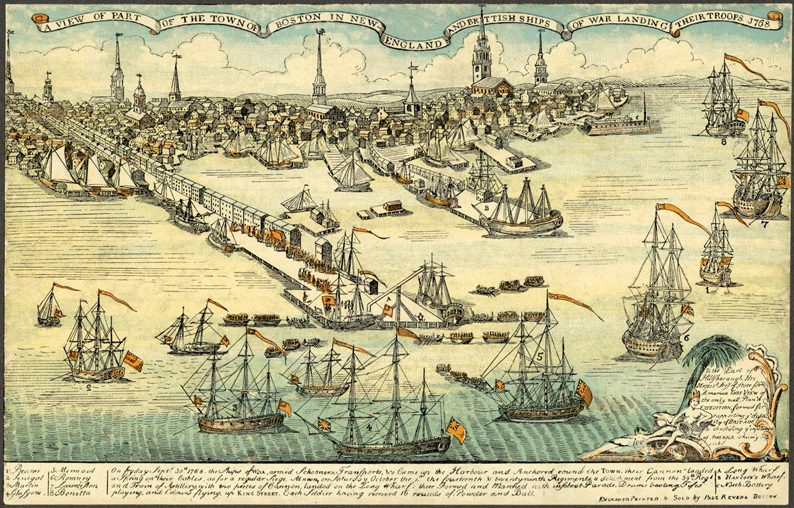
In 1768, British Parliament responded to the unrest in Boston by sending two regiments of British soldiers to the town. The colonists saw this as an occupying force. The regiments took up shelter on Boston Common and in Faneuil Hall, two prominent gathering locations for the townspeople. The conflict between these troops and the Boston populace would ultimately lead to the Boston Massacre 2 years later.
Tensions would continue through 1773 with the passage of the Tea Act. Under the Tea Act, the East India Company could ship tea directly to the American colonies to be sold by a select group of merchants called tea consignees. The tea was also “duty-free,” meaning, that any tea heading to North America would be free of the import duties imposed on tea as it entered London. The company also regulated the fees for the consignees, as well as the price of the tea. These were all intended to be incentives for people to take part in the tea trade, and help the company repay its loans to Parliament. The tea was now cheaper than ever, even with the meager 3-penny-per-pound tax imposed upon the tea’s arrival in North America.
Despite the apparent benefit from the law, Sons of Liberty throughout the colonies protested that this as another example of “taxation without representation”. They protested that the funds raised by the tax would not help the colony and would instead be used to pay un-elected officials, like the despised Gov. Hutchinson. Further, they were concerned that paying the tax, and supporting the law, would support Parliament’s authority over the colonies and weaken colonial authorities. Ultimately 340 chests of tea sent to Boston would be destroyed in Boston Harbor, proving that the colonists were willing to go to great lengths and take considerable risks to protest “taxation without representation”.