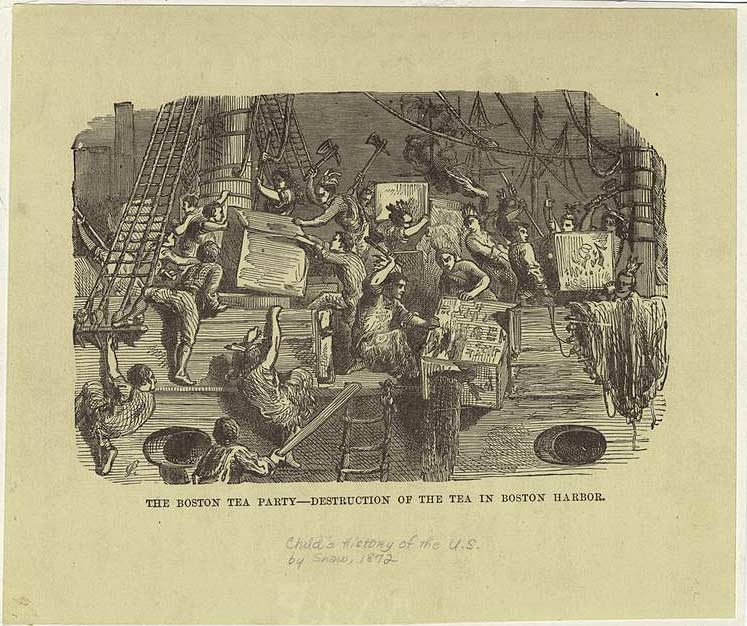
The Sons of Liberty.
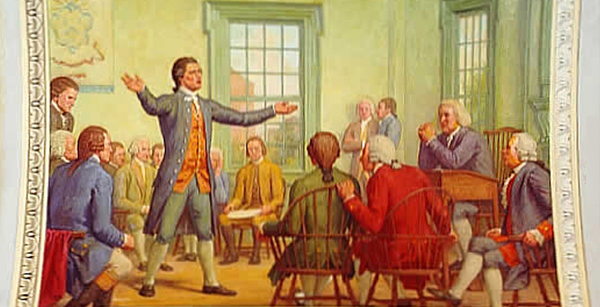
The Boston Tea Party was organized and carried out by a group of Patriots led by Samuel Adams known as the Sons of Liberty. The Sons of Liberty were made up of males from all walks of colonial society, and among its membership were artisans, craftsmen, business owners, tradesmen, apprentices, and common laborers who organized to defend their rights, and to protest and undermine British rule. Famous Boston Patriots who were members of the Sons of Liberty included John Adams, John Hancock, James Otis, Josiah Quincy, Paul Revere, and Dr. Joseph Warren. Incited by the Sons of Liberty, over 5,000 people gathered at the Old South Meeting House, the largest public building in Boston at the time, at 10:00 AM on December 16, 1773, to decide what was to be done about the tea and to plan the Boston Tea Party.
Many factors including “taxation without representation,” the 1767 Townshend Revenue Act, and the 1773 Tea Act.
In simplest terms, the Boston Tea Party happened as a result of “taxation without representation”, yet the cause is more complex than that. The American colonists believed Britain was unfairly taxing them to pay for expenses incurred during the French and Indian War. Additionally, colonists believed Parliament did not have the right to tax them because the American colonies were not represented in Parliament.
Since the beginning of the 18th century, tea had been regularly imported to the American colonies. By the time of the Boston Tea Party, it has been estimated American colonists drank approximately 1.2 million pounds of tea each year. Britain realized it could make even more money off of the lucrative tea trade by imposing taxes onto the American colonies. In effect, the cost of British tea became high, and, in response, American colonists began a very lucrative industry of smuggling tea from the Dutch and other European markets. These smuggling operations violated the Navigation Acts which had been in place since the middle of the 17th century. The smuggling of tea was undercutting the lucrative British tea trade. In response to the smuggling, in 1767 Parliament passed the Indemnity Act, which repealed the tax on tea and made British tea the same price as the Dutch. The Indemnity Act greatly cut down on American tea smuggling, but later in 1767 a new tax on tea was put in place by the Townshend Revenue Act. The act also taxed glass, lead, oil, paint, and paper. Due to boycotts and protests, the Townshend Revenue Act taxes on all commodities except tea were repealed in 1770. In 1773, the Tea Act was passed and granted the British East India Company a monopoly on tea sales in the American colonies. The smuggling of tea grew rampant and was a lucrative business venture for American colonists, such as John Hancock and Samuel Adams. The Townshend Revenue Act tea tax remained in place despite proposals to have it waived. American colonists were outraged over the tea tax. They believed the Tea Act was a tactic to gain colonial support for the tax already enforced. The direct sale of tea by agents of the British East India Company to the American colonies undercut the business of colonial merchants. The smuggled tea became more expensive than the British East India Company tea. Smugglers like John Hancock and Samuel Adams were trying to protect their economic interests by opposing the Tea Act, and Samuel Adams sold the opposition of British tea to the Patriots on the pretext of the abolishment of human rights by being taxed without representation.
December 16, 1773.
The Boston Tea Party took place on the winter night of Thursday, December 16, 1773. According to eyewitness testimonies, the Boston Tea Party occurred between the hours of 7:00 and 10:00 PM and lasted for approximately three hours.
Griffin’s Wharf.
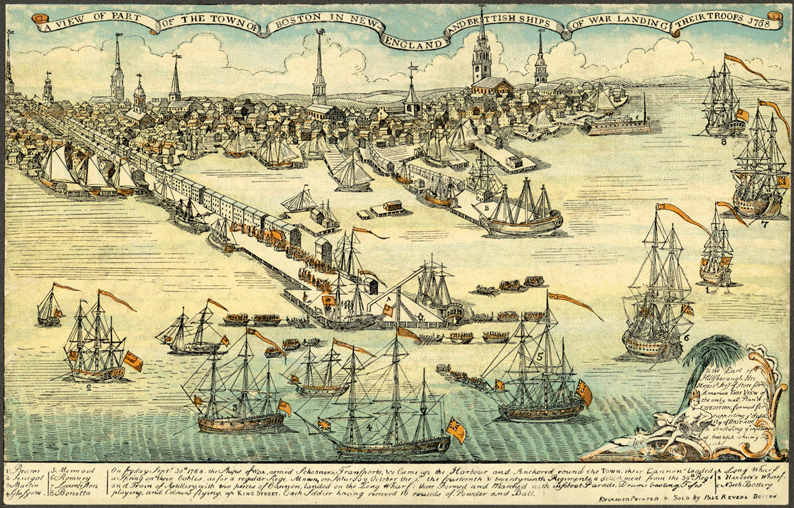
The Beaver, Dartmouth, and Eleanor were moored at Griffin’s Wharf in Boston. It is at this location where the December 16, 1773 destruction of the tea occurred. The original location of the Boston Tea Party no longer exists because of extensive landfills that destroyed the location. This was caused by the city of Boston’s rapid expansion in the 19th century. In 18th century Boston, Griffin’s Wharf was a bustling center for maritime commerce and shipping. The exact location of the original Griffin’s Wharf is open to debate, but the Boston Tea Party Ships & Museum, located on the Congress Street Bridge, is located near the approximate area where the Boston Tea Party took place. A historical marker commemorating the Boston Tea Party stands on the corner of Congress and Purchase streets.
Hundreds.
It is estimated that hundreds took part in the Boston Tea Party. For fear of punishment, many participants of the Boston Tea Party remained anonymous for many years after the event. To date it is known that 116 people are documented to have participated. Not all of the participants of the Boston Tea Party are known; many carried the secret of their participation to their graves. The participants were made up of males from all walks of colonial society. Many were from Boston or the surrounding area, but some participants are documented to have come from as far away as Worcester in central Massachusetts and Maine. The vast majority was of English descent, but men of Irish, Scottish, French, Portuguese, and African ancestry were documented to have also participated. The participants were off all ages, but the majority of the documented participants was under the age of forty. Sixteen participants were teenagers, and only nine men were above the age of forty. Many of the Boston Tea Party participants fled Boston immediately after the destruction of the tea to avoid arrest. Thousands witnessed the event, and the implication and impact of this action were enormous ultimately leading to the start of the American Revolution.
Learn More
American Indians.
In an effort to hide their true identities, many of the Sons of Liberty attempted to pass themselves off as Mohawk Indians because if caught for their actions they would have faced severe punishment. Reports from the time describe the participants as dressed as Mohawks or Narragansett Indians. The disguise was mostly symbolic in nature; they knew they would be recognized as non-Indians. The act of wearing “Indian dress” was to express to the world that the American colonists identified themselves as “Americans” and no longer considered themselves British subjects. They were not dressed as Indians in the classic sense with headdresses and full authentic regalia; rather they wore wool blankets matchcoat style, painted their faces with soot, and employed other modes of dress commonly known at the time as “Indian dress”, which had been adopted by soldiers during the French and Indian War. An observer of the Boston Tea Party, John Andrews wrote the following in 1773: “They say the actors were Indians… Whether they were or not to a transient observer they appear’d as such, being cloth’d in blankets with the heads muffled and copper color’d countenances, each being arm’d with a hatchet or ax, and pair pistols, nor was their dialect different from what I conceive these geniusses to speak, as their jargon was unintelligible to all but themselves.” Boston Tea Party participant George Hewes recorded the following: “It was now evening, and I immediately dressed myself in the costume of an Indian, equipped with a small hatchet, which I and my associates denominated the tomahawk, with which, and a club, after having painted my face and hands with coal dust in the shop of a blacksmith, I repaired to Griffin’s wharf, where the ships lay that contained the tea. When I first appeared in the street after being thus disguised, I fell in with many who were dressed, equipped and painted as I was, and who fell in with me and marched in order to the place of our destination.”
Three.
On the night of the Boston Tea Party, three ships that had sailed from London carrying cargoes of British East India Company tea were moored in Boston Harbor. The three ships were the Beaver, Dartmouth, and Eleanor. The Dartmouth arrived in Boston on November 28, 1773, the Eleanor on December 2, and the Beaver on December 15. Each of the three ships carried more than one hundred chests of British East India Company tea. The Sons of Liberty on the night of December 16, 1773, offloaded the tea cargoes of all three ships.
There were to be four ships sailing from London carrying cargoes of British East India Company tea to Boston, but the William ran aground off Cape Cod on December 10, 1773 in a violent storm. The cargo of 58 chests of British East India Company tea was salvaged before the William was abandoned. A portion of the salvaged tea cargo ended up in Boston and was later destroyed by the Sons of Liberty. Samuel Adams recorded the following about the fate of the William: “The only remaining vessel which was expected with this detested article, is by the act of righteous heaven cast on shore on the back of Cape Cod, which has often been the sad fate of many a more valuable cargo.”
If you would like more information about each of the ships, visit these links to dedicated pages:DartmouthEleanor
No.
A popular misconception is the belief the Tea Party Ships were British. In fact, the vessels were built in America and owned by Americans, but the cargo of tea they were carrying from London to Boston was owned by the British East India Company. The Beaver and Dartmouth were built and owned by the Rotch’s, an affluent Nantucket Quaker family. The Eleanor was one of several vessels owned by leading Boston merchant, John Rowe.
Learn More
China.
Contrary to popular belief, the British East India Company tea the Beaver, Dartmouth, and Eleanor transported to Boston was not from India. The tea the Sons of Liberty dumped into Boston Harbor was in fact from China. In addition to India, the British East India Company had extensive dealings in China because of the lucrative opium trade. The tea destroyed during the Boston Tea Party was described as “Bohea” type. In the 18th century tea trade, black tea was referred to as “Bohea.” Traditionally, the Bohea variety of black tea came from the Wuyi Mountains in the Chinese province of Fujian, but the term “Bohea” was hijacked by the tea trade to refer to all black tea varieties. The black teas (“Bohea”) the Beaver, Dartmouth, and Eleanor transported were of the Bohea, Congou, and Souchong varieties. Additionally, they also transported Hyson and Singlo teas, which were both green teas from the Chinese province of Anhui. The shipment of British East India Company tea the three ships delivered to Boston consisted of 240 chests of Bohea, 60 chests of Singlo, 15 chests of Congou, 15 chests of Hyson, and 10 chests of Souchong.
Tories, Loyalists, Royalists, or King’s men.
The terms Tory, Loyalist, Royalist, or King’s men were used by Patriots to label those who remained loyal to the mother country Britain. The word Tory comes from several Middle Irish words meaning robbers, outlaws or pursued men. Prior to the American Revolution, the term Tory evolved into describing those who upheld the right of the King over Parliament, and during the Revolution took on the form to describe anyone who remained loyal to Britain. The most famous Boston Tories and targets of the Sons of Liberty were public official Andrew Oliver and Lieutenant Governor and Chief Justice of Massachusetts Thomas Hutchinson. During the American Revolution, it is documented that over twenty thousand Tories took up arms and fought with the British Army against the Patriots. They were branded traitors for remaining loyal to their king and fighting for what they believed in. When American independence was achieved at the close of the American Revolution, many Tories either fled or were kicked out of the newly formed United States and relocated primarily to Britain, Canada, the Bahamas, and Africa where they founded Sierra Leone. During the American Revolution it is estimated one-third of the population of the Thirteen Colonies were Tories, one-third were Patriots, and one-third remained neutral.
£9,659 worth of damage in 1773 currency.
340 chests of British East India Company tea, weighing over 92,000 pounds (roughly 46 tons), onboard the Beaver, Dartmouth, and Eleanor were smashed open with axes and dumped into Boston Harbor the night of December 16, 1773. The damage the Sons of Liberty caused by destroying 340 chests of tea, in today’s money, was worth more than $1,700,000 dollars. The British East India Company reported £9,659 worth of damage caused by the Boston Tea Party. According to some modern estimates, the destroyed tea could have brewed 18,523,000 cups of tea! The destruction of the tea was a very costly blow to the British. Besides the destruction of the tea, historical accounts record no damage was done to any of the three ships, the crew or any other items onboard the ships except for one broken padlock. The padlock was the personal property of one of the ships’ captains and was promptly replaced the next day by the Patriots. Great care was taken by the Sons of Liberty to avoid the destruction of personal property – save for the cargo of British East India Company tea. Nothing was stolen or looted from the ships, not even the tea. One participant tried to steal some tea but was reprimanded and stopped. The Sons of Liberty were very careful about how the action was carried out and made sure nothing besides the tea was damaged. After the destruction of the tea, the participants swept the decks of the ships clean, and anything that was moved was put back in its proper place. The crews of the ships attested to the fact there had been no damage to any of the ships except for the destruction of their cargoes of tea.
No.
No one died during the Boston Tea Party. There was no violence and no confrontation between the Patriots, the Tories and the British soldiers garrisoned in Boston. No members of the crews of the Beaver, Dartmouth, or Eleanor were harmed. This was the first organized act of rebellion against British rule, and the Sons of Liberty were very careful about how the Boston Tea Party was planned and executed. In fact, only one member of the Sons of Liberty, Francis Akeley, was caught and imprisoned for his participation. He was the only person ever to be arrested for the Boston Tea Party.
Boston Harbor was shut down.
For weeks after the Boston Tea Party, the 92,000 pounds of tea dumped into the harbor caused it to smell. As a result of the Boston Tea Party, the British shut down Boston Harbor until all of the 340 chests of British East India Company tea were paid for. This was implemented under the 1774 Intolerable Acts and known as the Boston Port Act. The Intolerable Acts outraged and unified the American colonists even more against British rule. In addition to the Boston Port Act, the Intolerable Acts also implemented the Massachusetts Government Act, the Administration of Justice Act, the Quartering Act, and the Quebec Act. American colonists responded with protests and coordinated resistance by convening the First Continental Congress in September and October of 1774 to petition Britain to repeal the Intolerable Acts. The Boston Tea Party was the first significant act of defiance by American colonists. The implication and impact of the Boston Tea Party was enormous ultimately leading to the sparking of the American Revolution which began in Massachusetts on April 19, 1775.
George Washington
While he was in absolute favor of the revolution, George Washington did not approve of the destruction of the tea. It was against his beliefs about property ownership.
It wasn’t actually called The Boston Tea Party until much, much later.
The Boston Tea Party name did not come about until the early 1820’s. Before that, the event was deemed a much less creative name, “the destruction of the tea.”
There was a second Boston Tea Party three months later.
In March of 1774, 60 men disguised themselves and boarded the Fortune to threw 30 chests of tea overboard. Being a much smaller protest, it did not get the attention of the original.
There was only one person injured in the event (and they mistakenly thought he was dead).
John Crane was thought to be dead when he was knocked unconscious during the Boston Tea Party. His fellow patriots hid him under a pile of wood shavings in a nearby shop. He regained consciousness a few hours later and was the only person injured during the protest.
Benjamin Franklin offered to pay for the tea that was dumped.
Ben Franklin was a rich and generous man and as such, he offered to pay for the tea on the condition that Britain would reopen the harbor. They refused, so they were never compensated.
The participants were never punished.
There was a strict code of secrecy surrounding the events of the Boston Tea Party and as a result, no one ever identified who the participants were. One person was named in an anonymous tip, and he was stripped, tarred and feathered. After and since, no one else ever came forward with any information.
It was an expensive protest.
If measured in today’s financial terms, the value of the more than 92,000 pounds of tea dumped into the Boston Harbor would be around $1 million.
The location of the protest is now a busy street corner.
The actual location of the Boston Tea Party is thought to be at the corner of Congress and Purchase Streets—once under water, it is now a busy intersection.