In-Season Hours: Tours begin at 10a, last tour 5p. Plan Visit >
Scene at the Signing of the Constitution of the United States, 1940, Howard Chandler Christy, Oil on Canvas, The House of Representatives

Scene at the Signing of the Constitution of the United States, 1940, Howard Chandler Christy, Oil on Canvas, The House of Representatives

The Effects of the American Revolution

Throughout time, revolutions have changed the course of human history. Perhaps no revolution, however, has had such a resounding effect on world history as the American Revolution.

The American Revolution took place in the mid to late 18th century in the formerly British North American colonies. It occurred during what is often referred to as “The Age of Enlightenment”, which saw great advancements in science and technology, as well as vast cultural and political shifts across the globe. This time period is also often regarded as the era of “American Enlightenment” as the effects of the American Revolution would ignite similar societal change in nations around the world.

The Boston Tea Party’s Effect on the American Revolution

The Boston Tea Party’s Effect on the American Revolution would be profound. The Destruction of the Tea in 1773 would prove to be a catalyst that quickened the separation between Great Britain and her colonies in North America and propel America down the road to revolution. The Boston Tea Party took place on December 16, 1773, but the seeds of the tea’s destruction were sown years before. For years, the colonists had been taxed by Parliament without their consent. This taxation without representation would lead to widespread protests and unrest. The Stamp Act of 1765 was the first direct tax levied upon the colonies, requiring a stamp to be placed on paper goods such as newspapers, legal documents, bills of sale, diplomas, and even marriage licenses and death certificates. This led to riots and protests across the town. To quell Boston’s rage, Parliament repealed the Stamp Act, but at about the same time passed the Declaratory Act, which reasserted Parliament’s political dominance in the American colonies. Then came the Townshend Acts in 1767 which placed a tax on glass, lead, paint, paper, and tea. The Townshend Acts also established a board of customs commissioners in Boston, and a stringent arbitrary construct of paid colonial informants, spies, and customs officers who administered search warrants and writs of assistance. The revenue collected went toward paying the salaries of royally appointed governors, judges, officials, and military expenses. The predictable colonial response to this was more protests and unrest.

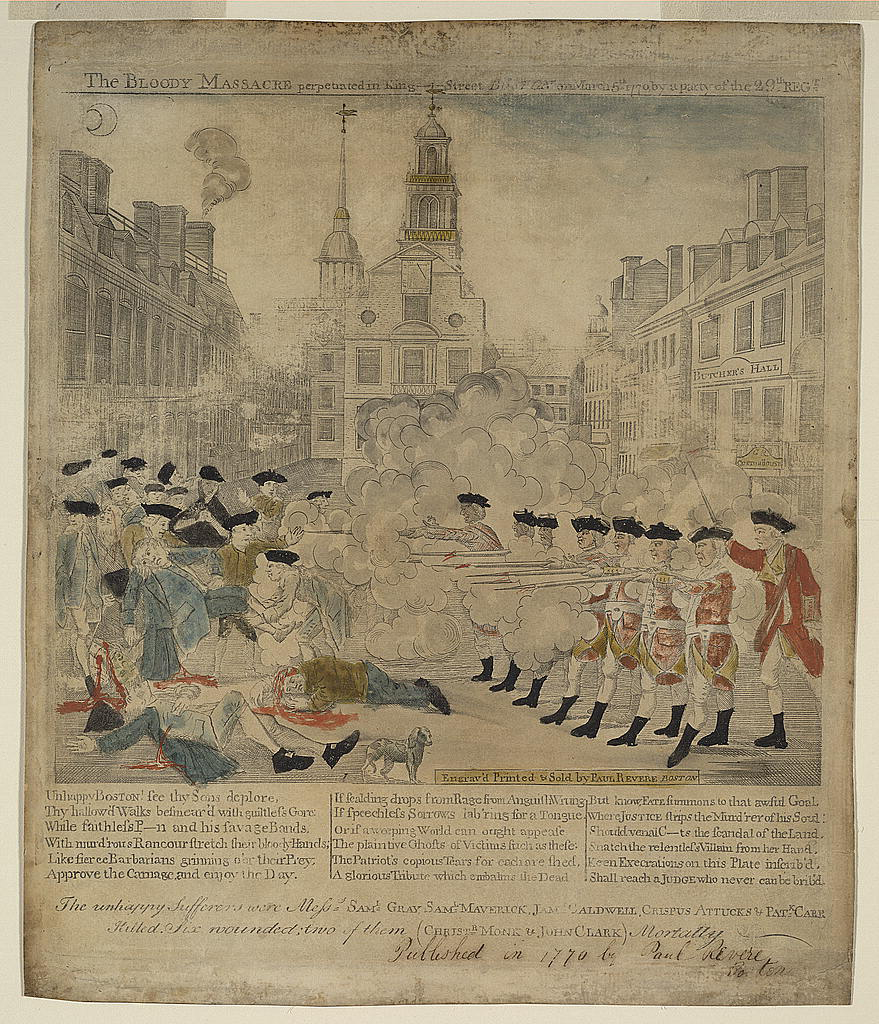
Tensions deepened in late 1768, when 2,000 British soldiers were stationed in Boston among the populace. A year and a half of tension exploded on March 5, 1770, when British soldiers fired into a crowd of angry Bostonians, killing 5 in an event that would come to be known as the Boston Massacre. Ironically, on the very same day as the Boston Massacre, Parliament repealed the Townshend Acts. This repeal removed the taxes on most other goods, but kept the tax on tea in place. This tax on tea was reinforced by the Tea Act of 1773 which gave the EIC the ability to sell its tea duty free.

East India Company Shares plunged on the London Stock Exchange that same year, as nearly 17 million pounds of surplus tea sat in London warehouses. Parliament decided to use the sale of tea as a means to buoy up the faltering company. The Tea Act effectively handed the company complete control of the tea trade in the American colonies, and a monopoly on the sale of tea. The act also allowed the East India Company to ship tea directly to America, rather than selling it publicly at the London Tea auction. The tea was then sent to trusted agents in America called “consignees” who would pay the tea tax upon importation, and then offer the tea for wholesale to American markets. Bostonians were irate that these consignees were hand-picked by Parliament, with two of them being Royal Governor Thomas Hutchinson’s own sons.

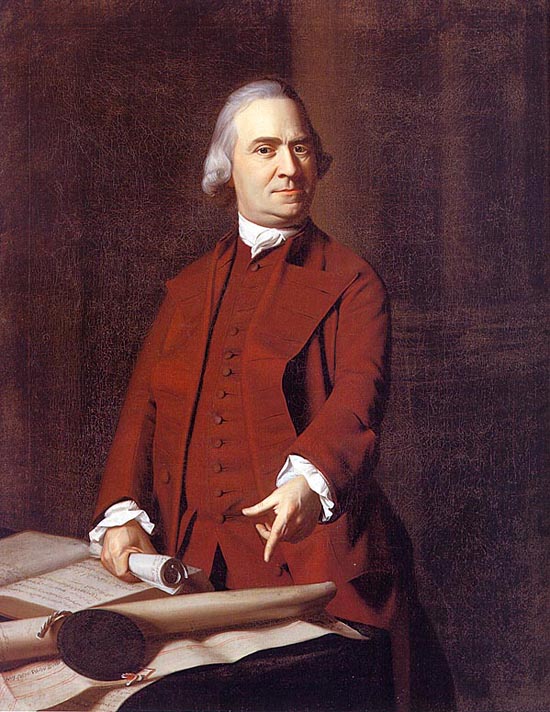
Portrait of Samuel Adams
Portrait of Samuel Adams, 1772, John Singleton Copley, Oil on Canvas, Museum of Fine Arts Boston

This tension and resentment reached a boiling point with the arrival of three ships carrying East India Company tea. The first vessel to arrive was called the Dartmouth, and with her arrival a dramatic series of tense negotiations, petitions, and meetings of the Body of the People would begin. The Sons of Liberty, led by Samuel Adams, hoped that the tea could be sent back to England. However, all those requests were denied. On December 16, 1773, Francis Rotch, owner of the ship Dartmouth, was sent one final time to petition Royal Governor Thomas Hutchinson for permission to return his ship to England without unloading the tea. This last request was denied as well. With the expiration of a 20-day deadline looming, and all other options exhausted, the Sons of Liberty marched to Griffin’s Wharf, boarded three ships, and destroyed 340 chests of East India Company Tea. In total, 92,616 pounds of tea was destroyed with a monetary value totaling approximately $1.5 million in modern currency. This event would shock Great Britain, and prove that American colonists were willing to go to great lengths to defend their liberties.

Parliament’s reaction to the Destruction of the Tea was as swift as it was harsh. In 1774, Parliament passed the Coercive Acts, also known as the Intolerable Acts. This act would lead to a blockade of Boston Harbor and a substantial altering of the local government— all with an attempt to punish Boston and defuse the growing rebellion. What began as an attempt by Parliament to isolate Boston, however, backfired, and the “plight of Boston” became a unifying cause for the other colonies. Ultimately, the Boston Tea Party’s effect on the American Revolution was substantial. Only 16 months following the Boston Tea Party, the first shots of what would become the American Revolution would be fired leading to war between America and Great Britain.

americans throwing tea into the boston harbor
Americans throwing Cargoes of the Tea Ships into the River, at Boston, 1789, W.D. Cooper, Engraving, Library of Congress
Open Image
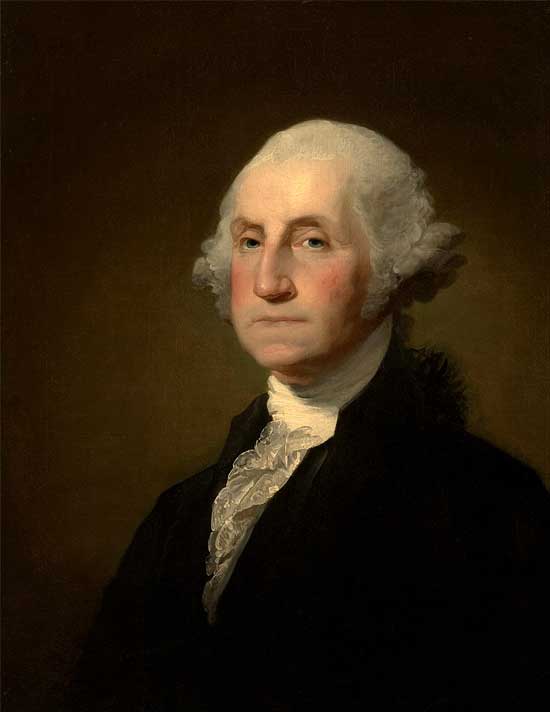
George Washington, 1803, Gilbert Stuart, Oil on Canvas, Clark Art Institute

Results of the American Revolution

#1 The Establishment of the United States of America

As a result of the American Revolution, the United States of America was born. Following the cessation of the Revolutionary War, many of the same individuals who nurtured the idea of American independence, went to work to support the foundation of a new republic. State constitutions were drafted and ratified. After first adopting the Articles of Confederation, the United States Constitution was drafted in 1787. This document would become the foundation of the American Federal Government. George Washington emerged as a natural choice for leader as a result of the American Revolution and was unanimously selected as President of the Constitutional Convention, and eventually the first person to sign the document. The United States Constitution was officially adopted on June 21, 1788.

constitution of the united states of america
Constitution of the United States, 1787, National Archives and Records Administration

#2 An Emphasis on Democracy

One of the effects of the American Revolution was the constitutional framework of putting the power of the government into the hands of the people. The nation’s founders hoped to create a democratic system where its citizens would have a say in who would hold office, and where a system of checks and balances would ensure that no singular branch of government would become too powerful to where its people would again be subjected to tyrannical or monarchical rule.
The United States Constitution contains a section that was considered groundbreaking at the time of its conception: the Bill of Rights. This framework grants U.S. citizens certain inalienable rights. This result of the American Revolution can be seen in America’s freedom of speech, freedom of press, freedom of religion and others.

It should be noted that these rights were not immediately afforded to all people living within the newly formed United States of America. While the U.S. Constitution granted white land-owning men the right to vote, women were not afforded this right. Through years of protest, and civic engagement, the women’s suffrage movement would lead to the 19th Amendment to the U.S. Constitution in 1920, officially granting women the right to vote.

Additionally, by the end of the American Revolution, around 500,000 people of African descent lived in the American colonies. Some 450,000, or 90% of these individuals were enslaved. Black Soldiers in the Continental Army and states militias fought in every major battle of the Revolutionary War. The war had both positive and negative effects on the black population of America. On one hand, the American Revolution helped to weaken slavery to some degree as some enslaved men who fought in the war were manumitted following their service. Other enslaved individuals were able to leverage the confusion of the war to flee the colonies to Canada and other areas outside of colonial control. The American Revolution also helped to begin a buildup of an abolitionist sentiments.

It must be acknowledged, however, that following the American Revolution, the newly formed United States of America still embraced the institution of slavery. The U.S. Constitution strengthened and legitimized the institution of slavery by allowing slaves to continue to be imported to the country, establishing a benchmark that an enslaved individual would only count as “three-fifths of a person” for tax purposes, and offering federal assistance in apprehending runaway slaves who crossed state lines. These federal structures encouraged more enslaved people to be brought into the United States. In fact, between 1787 and 1808, more enslaved peoples were brought into the country than during any other period of the American slave trade. It would not be until 1863, as the nation approached its 3rd year of Civil War, that President Abraham Lincoln would issue the Emancipation Proclamation which declared “that all persons held as slaves are and henceforward shall be free.” Even with their freedom from enslavement proclaimed to them, African Americans would wait until 1870 when the 15th Amendment extended voting rights to men of all races. Sadly, this amendment did not prevent state constitutions and state laws from working to prevent people of color from voting in elections. It was not until the 1964 ratification of the 24th Amendment and the Voting Rights Act of 1965 that the right to vote was federally protected for adult citizens of all races and genders.

Ultimately, the results of the American Revolution impacted every level of American life, and its far-reaching consequences can be seen in every chapter of American history.

part of charleston harbor
Part of Charleston Harbor, Embracing Forts Moultrie, Sumter, Johnson, and Castle Pinckney, also Sullivan, James & Morris Islands, Philadelphia: P.S. Duval & Son, George T. Perry, 1861, Geography and Map Division, Library of Congress

#3 The Separation of Church and State

Freedom of religion was a key result of the American Revolution. The American colonies were initially founded in a search for religious freedom. While the Puritans themselves were not necessarily known for their religious tolerance, one result of the American Revolution was the separation of church and state, which was codified for the first time in an official charter of government. The first recorded thematic mention of this term was likely made by Puritan Minister Roger Williams around 1644. He called for a “wall or hedge of separation” between the “wilderness of the world and the garden of the church.”. The first recorded specific mention of this exact phrase was coined by Thomas Jefferson in an 1802 letter to members of the Danbury Baptist Association in Connecticut. In his letter, Jefferson explained the importance of preventing the establishment of a national church, and in doing so, preventing government interference into the rights of religious expression.

#4 The Expansion of the United States of America

One of the effects of the American Revolution was the rapid expansion of the United States of America. It did not take long for the United States to expand in terms of geography and international influence. Through the idea of Manifest Destiny, the U.S. pushed westward.

Manifest Destiny was the idea that Americans were somehow divinely ordained to settle the North American continent from coast to coast. This proved to be one of the harshest effects of the American Revolution for Native Americans. This policy attempted to justify the removal and subjugation of indigenous peoples, leading to the destruction of their traditional ways of life and displacement from their ancestral lands. During this expansion, conflicts arose leading to tension, military conflict, and death. Manifest Destiny also impacted the growing debate over slavery. As the nation expanded westward, and new states were formed, the question of whether new states would allow slavery was brought to the forefront. This conflict would eventually lead to Civil War. This mission of continental expansion came about in the 19th century and peaked under James K. Polk’s presidency from 1845 to 1849. It was one of the later effects of the American Revolution, and undoubtedly changed the course of history.

The expansion of the United States was not limited to the North American continent, as the Monroe Doctrine established America’s intention to peddle influence throughout the Western Hemisphere, namely South America, without any interference from European powers. The 13 colonies expanded rapidly as a result of the American Revolution, growing to the 50 states we know today, as well as territories in the Virgin Islands, Puerto Rico, Guam — not to mention embassies and diplomatic relations with a large number of other countries.

#5 A Changes Relationship with the United Kingdom

Naturally, the years immediately following the American Revolution saw a tumultuous relationship between the United States of America and Great Britain. The Boston Tea Party’s effect on the American Revolution led to a full separation from Great Britain and war. The bad blood between nations reached a second boiling point during the War of 1812, a second major war between the United States and Great Britain fought on American soil. The War of 1812 was fought over a number of issues including trade disagreements, naval impressment of American sailors by the British Navy, as well as western expansion and policies regarding Native Americans. During this conflict, Washington, D.C. and the White House was burned during a British amphibious assault in 1814.

Years later, however, the relationship between the United States and Great Britain would improve dramatically. During World War I and World War II, the U.S. and Great Britain were close allies. Today, no two countries are more closely aligned politically, economically, and militarily than the United States and Great Britain.

#6 The Idea of Republican Motherhood and Women’s Education

One of the effects of the American Revolution was the challenging of many gender roles across colonial society. In many ways, the necessary changes to ordinary life during the conflict between Great Britain and her colonies in America forced many women to act outside more traditional gender expectations. While men left their homes to fight, many women were left to care for their families, homes, and businesses. Some women raised money for the Continental Army, made their voices heard politically, signed petitions, and took part in protests and non-consumption efforts during the boycotts of taxed British goods. While these actions were seen as patriotic for true “Daughters of Liberty”, the American Revolution failed to create permeant changes in status for American women. At wars end, the majority of American women returned to a strictly domestic role. In an article on the rights of women Mary Wollstonecraft argued, “if children are to be educated to understand the true principle of patriotism, their mother must be a patriot…but the education and situation of a woman at present shuts her out.” However, the concept of “Republican Motherhood” did in some ways advance women’s education reform. This increase in women’s s education was an effect of the American Revolution as women’s schools became more prevalent. New England schools were especially keen on offering women’s education and offered thorough curricula well into the 19th century. While the intended purpose of “Republican Motherhood” was initially to keep women more traditionally confined to the domestic sphere, women of the early American republic were better educated, and therefore became more politically active. This education would prove an important result of the American Revolution as women’s voices would prove invaluable in the abolition movement and women’s suffrage movements of the 19th century.

FAQs

The American Revolution had wide-ranging effects on the North American continent and the world. Perhaps the biggest were the birth of a world power, further revolution worldwide and the evolution of the relationship between the United States and Great Britain from foes to friends. At its core, the result of the American Revolution was the popularization of new ideas and a willingness to strive and for liberty, equality, and governance by the people.

The effects of the American Revolution were felt worldwide and encouraged an increase in civic participation, personal freedoms, and religious tolerance. Additionally, an obvious result of the American Revolution would be the formation of the United States of America, an eventual world power who would become global leader of industry, education, and military prowess. The Boston Tea Pary’s effect on the American Revolution, as well as the effect of other revolutionary events would prove to be inspirational reminders of America’s struggle for freedom from tyranny.

However, the American Revolution was also costly. While the newly formed United States of America spread westward, this led to persecution and subjugation of Native Americans, as many tribes were displaced, and in some cases wiped out. Additionally, an early lack of commitment to abolishing slavery would lead to eventual conflict and Civil War. This conflict would see more casualties than any other American-fought war.

The American Revolution was an event that upended political, economic, societal, and miliary norms around the world. It produced revolutionary documents such as the Declaration of Independence and the United States Constitution, in which the American people are guaranteed certain inalienable rights such as life, liberty, and the pursuit of happiness. The American Revolution set an example for the rest of the world that oppression and tyranny can be defeated and can inspire a more equitable world for all.

Boston Tea Party Ships & Museum Profile Picture

Boston Tea Party Ships & Museum

This page was developed with the help of one of our great cast members here at the Boston Tea Party Ships & Museum®.

SIGNUP FOR SPECIALS & DISCOUNTS

Sign up to receive special offers, discounts and news on upcoming events.