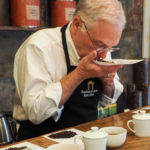
The Tea Master's Blog

Author: Bruce Richardson
Tea Master for the Boston Tea Party Ships and Museum

Mr. Richardson, a native Kentuckian, is a leading tea expert and spends much of his time educating Americans in the art of celebrating the communal cup of tea. He is a writer, photographer, tea blender, and frequent guest speaker at tea events across the country. and can often be found appearing on television and radio talk shows, or as a guest speaker at professional seminars such as World Tea Expo.
Books
  • The Great Tea Rooms of Britain
  • The Great Tea Rooms of America
  • The New Tea Companion for The National Trust of England with London's Jane Pettigrew
  • Tea in the City, a three-volume set of travel guides to tea in New York, London and Paris with Jane Pettigrew and Elizabeth Knight.
  • Tea & Etiquette


Accomplishments
  • Owner of Elmwood Inn Fine Teas and Benjamin Press
  • Contributing editor and designer for the 2011 edition of The Book of Tea by former Boston MFA Asian Arts Director, Okakura Kakuzo.
  • Columnist for Tea Time magazine

George Washington and Tea

April 24, 2013 by Bruce Richardson

Although tea drinking was considered unpatriotic during Revolutionary years, General George Washington must have enjoyed it while headquartered at the Morris-Jumel mansion during the Battle of Harlem Heights on September 16, 1776. His household inventory recorded several sets of Chinese and Wedgwood tea wares.
When a stash of tea was discovered hidden in some woods, [...]

Read More...

Sir Thomas Lipton’s Roots in American Soil

April 10, 2013 by Bruce Richardson

How did Britain’s greatest tea mogul come to work on a rice plantation in South Carolina?
The front page of the October 25, 1899 Georgetown (SC) Semi-Weekly Times reported a rumor from Washington, DC that famed grocer and tea entrepreneur Sir Thomas J. Lipton was determined to invest $500,000 in tea culture in South Carolina -
Sir [...]

Read More...

Was Brick Tea Tossed into Boston Harbor?

April 1, 2013 by Bruce Richardson

Still today, I sometimes see this idea mentioned in historical accounts of the Boston Tea Rebellion.
The answer is no.
According to Okakura Kakuzo in The Book of Tea, the evolution of Chinese tea may be roughly divided into three main stages;  Boiled tea, Whipped tea, and Steeped tea.
The Cake tea stage in which it was boiled, [...]

Read More...

19th Century Tea News

February 28, 2013 by Bruce Richardson

One of my favorite tea artifacts is a copy of THE PENNY MAGAZINE OF THE SOCIETY FOR THE DIFFUSION OF USEFUL KNOWLEDGE, published in London in April 28, 1832. The front page of that edition contains a lengthy essay on the production of tea in China. Here is a short snippet from that treatise -
It [...]

Read More...

Tea Appears in the New World

February 20, 2013 by Bruce Richardson

Governor Peter Stuyvesant
America’s interest in tea began not in Boston, but 200 miles south in the Dutch colony of New Amsterdam. By 1640, Chinese tea had been introduced to the Netherlands by the Dutch East India Company and infused into the daily life of the monarchy, the House of Orange. Although there were no specific [...]

Read More...

Liberty Teas of Colonial Boston

January 30, 2013 by Bruce Richardson

Colonists rejected King George’s tea in favor of local concoctions
As the tea dust rose above the water of Boston Harbor following the 1773 rebellion, colonists faced a minor dilemma. What would they to do to assuage the tea habit that was so ingrained in Boston society?
Colonial ladies still had their tea tables, cups, and equipage, [...]

Read More...

Recycling Used Tea Leaves into Smouch

January 22, 2013 by Bruce Richardson

According to some estimates, as much as three-quarters of the tea imported into 18th century America was smuggled, mostly from The Netherlands, France, Sweden and Denmark.  King George’s taxes not only encouraged widespread smuggling,  both in the colonies and in England, it also led to the recycling of spent tea leaves into what was known, [...]

Read More...

The Journey of Tea from China to London

December 29, 2012 by Bruce Richardson

Chinese Tea Garden
For the East India Company, the transport of tea from Canton to London was both complicated and protracted. Farmers all over China grew tea as one of various crops on their smallholdings. The first two pickings of the spring season yielded the best quality and were mainly exported. Third and fourth pluckings from [...]

Read More...

When Do You Add Milk to Tea?

December 17, 2012 by Bruce Richardson

The habit of putting milk in tea reportedly started in France. Madame de Sévigné described how Madame de la Sablière launched the fashion:
Madame de Ia Sahlière took her tea with milk, as she told me the other day, because it was to her taste.
The Chinese black teas imported into colonial Boston surely would have tasted [...]

Read More...

Thomas Jefferson’s Love for Tea

December 4, 2012 by Bruce Richardson

Thomas Jefferson was an early “foodie” and his great passion for food and drink included Chinese tea, both black and green.  According to the archives of Monticello, Jefferson’s financial records and correspondence show consistent purchases of tea and provide valuable information about the kinds and amounts of tea he and his family drank.
The few references [...]

Read More...
