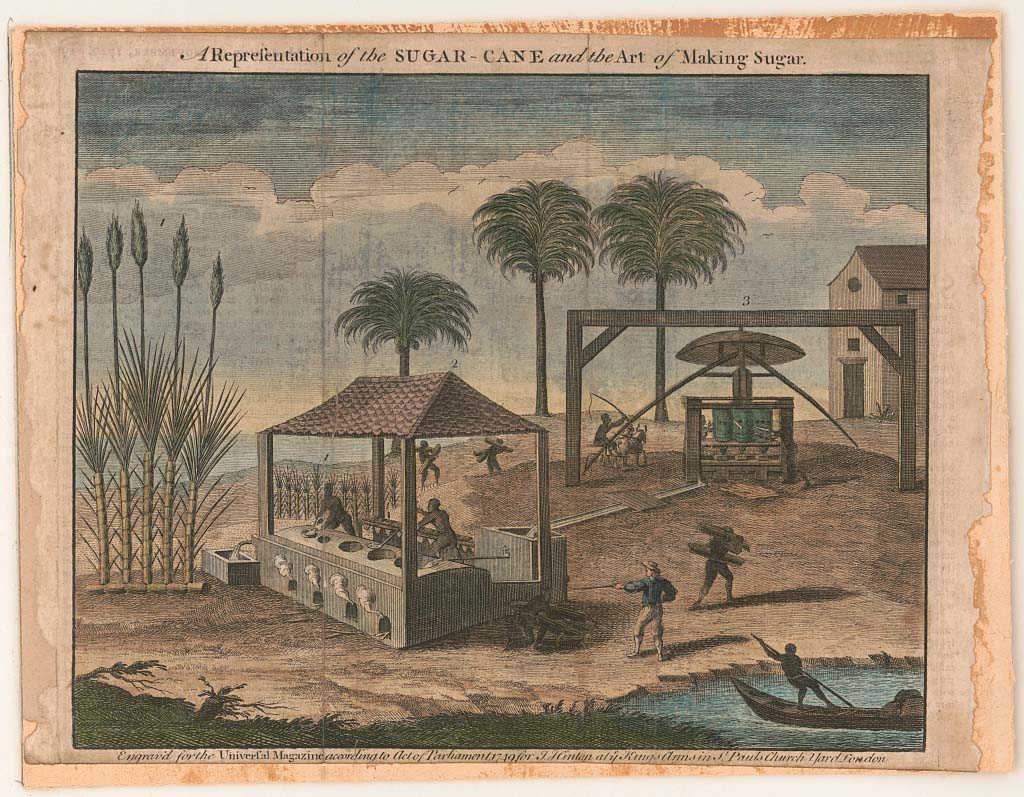
A representation of the sugar-cane and the art of making sugar, John Hinton, 1749, Engraving, Library of Congress.
A representation of the sugar-cane and the art of making sugar, John Hinton, 1749, Engraving, Library of Congress.
The Sugar Act was a British Act of Parliament passed on April 5, 1764. The act revised the largely ineffective Molasses Act of 1733, which had imposed a tax of six pence per gallon on imported molasses from non-British Caribbean colonies. Molasses was used in the distillation of rum which was one of the leading industries in Boston and New England. The Molasses Act specifically aimed at arranging a monopoly of the American sugar market for the British West Indies sugarcane growers. These growers were falling behind their French competitors and other producers on neighboring islands. Similarly to the Tea Act, which would be passed some years later, the Molasses Act was passed not only to raise revenue, but also to attempt to create a monopoly on the trade of certain goods by making British goods cheaper than those from the French West Indies.
Molasses was an important staple in the American colonies, particularly in New England. Large quantities would be sold to New England distilleries where the molasses would then be used to make rum. Colonists protested the Molasses Act and made claims that the monopoly would limit the supply of molasses and not meet consumer needs. Additionally, the colonists feared this scarcity would drive up prices of rum manufactured in New England. To circumvent this tax, smugglers easily snuck French rum into the colonies, and commonly bribed customs officials.
The Sugar Act was Parliament’s attempt to end this smuggling of sugar and molasses while simultaneously increasing revenue to offset the expenses of the recent French and Indian War.
The Sugar Act reduced the tax to three pence per gallon, but it also increased enforcement of the tax and broadened its scope to include other goods, such as sugar, coffee, certain wines, pimento, and cambric and printed calico textiles.
While not connected to the same level of unrest as caused by the Stamp Act and other acts of Parliament in subsequent years, the Sugar Act would become one of the factors that contributed to the American Revolution. It helped to raise tensions between the colonies and Great Britain, and it led to the passage of other unpopular taxes. The Sugar Act is also seen as one of the first steps in Great Britain’s attempt to assert greater control over the colonies.


The Sugar Act was passed by Parliament in an effort to raise revenue to help pay for the costs of the Seven Years’ War or the French and Indian War. The war had been expensive, and Parliament was looking for ways to raise money without raising taxes on the British people. Prime Minister George Grenville was faced with large budgetary concerns when it came to maintaining troops in the colonies and expected the colonies to offset some of the cost of this military protection.
The Commissioners of Customs also expected a higher demand for molasses and rum following the war and land acquisitions in Canada and were eager to profit from that anticipated demand. In 1764, Parliament passed the new Sugar Act which halved the prior tax rate on molasses. However, regulations were far more strictly enforced than during the time of the Molasses Act. The Sugar Act sought to protect British sugar producers and give them a monopoly on the sugar trade. Additionally, the language of this act made it very clear that the purpose of the Sugar Act was to not simply regulate trade, but to raise revenue for Great Britain.
In addition to sugar, this act listed other goods that were to be regulated. Lumber, which was a critical resource and key to New England seaports, could only be exported to Great Britain while lumber exports elsewhere in Europe were banned.
The Sugar Act was a tax on molasses imported into the American colonies. The tax was set at three pence per gallon, which was a significant reduction from the previous tax of six pence per gallon.
However, the Sugar Act increased stricter enforcement of customs, which made it more difficult for colonists to avoid paying taxes and smuggling goods into the colonies. More than half of the regulations under the Sugar Act were tied to enforcement. Customs officials were required to report to their posts, instead of appointing replacements who were more susceptible to bribes. Ship captains were required to carry affidavits attesting that their cargo was legal and approved. At any stop throughout their voyage, this paperwork was scrutinized by officials and the Royal navy.
The Sugar Act also led to an increase in Parliamentary control in the American colonies. While the Sugar Act severely hindered the colonists’ ability to smuggle molasses, some smuggling did continue. However, those still smuggling were taking a massive risk. Customs officials were granted the authority to have customs violations tried in vice admiralty courts in Nova Scotia, instead of trial by jury in colonial courts. This led to concerns among the colonists that the Parliament was attempting to take away their English rights and liberties.
The Sugar Act was met with widespread opposition in the American colonies. It upset the longstanding commercial and political relationship with Great Britain. The colonists objected to the tax on molasses, which was a major commodity in the colonial economy. They also objected to the increased enforcement of the tax, which they saw as an infringement of their rights as Englishmen.
As the Sugar Act came at a time of significant economic downturn, it was met with strong resentment. Merchants and those involved in shipping were the hardest hit. New England ports were also negatively impacted by the Sugar Act and saw revenue from their rum exports decrease substantially.
While the Sugar Act led to much resentment, violent protests, similar to those during the time of the Stamp Act, were not very common. What protests did occur against the Sugar Act were largely led by Samuel Adams and James Otis Jr. of Massachusetts. In the summer of 1764, Otis would write The Rights of the British Colonies Asserted and Proved. In this article he would lay the foundation for the argument for colonial representation in Parliament by saying, “Taxes are not to be laid on the people, but by their consent in person or by deputation.” He would later add that the Sugar Act was “absolutely irreconcilable with the rights of the colonists as British subjects and as men.”
In 1764, Samuel Adams wrote a report for the Massachusetts Assembly in which he declared the Sugar Act as an infringement of the rights of the colonists.
In August of 1764, 50 Boston merchants protested the Sugar Act by refusing to purchase British luxury imports. Efforts were also made to increase colonial manufacturing across several colonies to avoid having to purchase these British goods.
The most radical protests associated with resistance against the Sugar Act took place in Rhode Island. Much like Massachusetts, Rhode Island’s economy depended on the molasses trade. In December of 1764, a colonial ship was detained by the Royal Navy due to suspected smuggling. During a tense inspection, a colonial sailor attacked a British naval lieutenant, leading to a brawl. Several men were thrown overboard, and one colonial sailor was killed. Another incident in Rhode Island occurred when an argument over molasses smuggling led to colonists firing cannons at the Royal Navy schooner St. John as it sailed out of Newport Harbor. On July 6, 1764, the St. John was lying at anchor off Newport as part of anti-smuggling operations. Members of the Rhode Island General Assembly and a group of local residents seized control of Fort George on Goat Island and fired 13 shots from the fort’s 18-pounder long guns. While the St. John was only slightly damaged, this incident marked one of the first violent confrontations of the American Revolution.
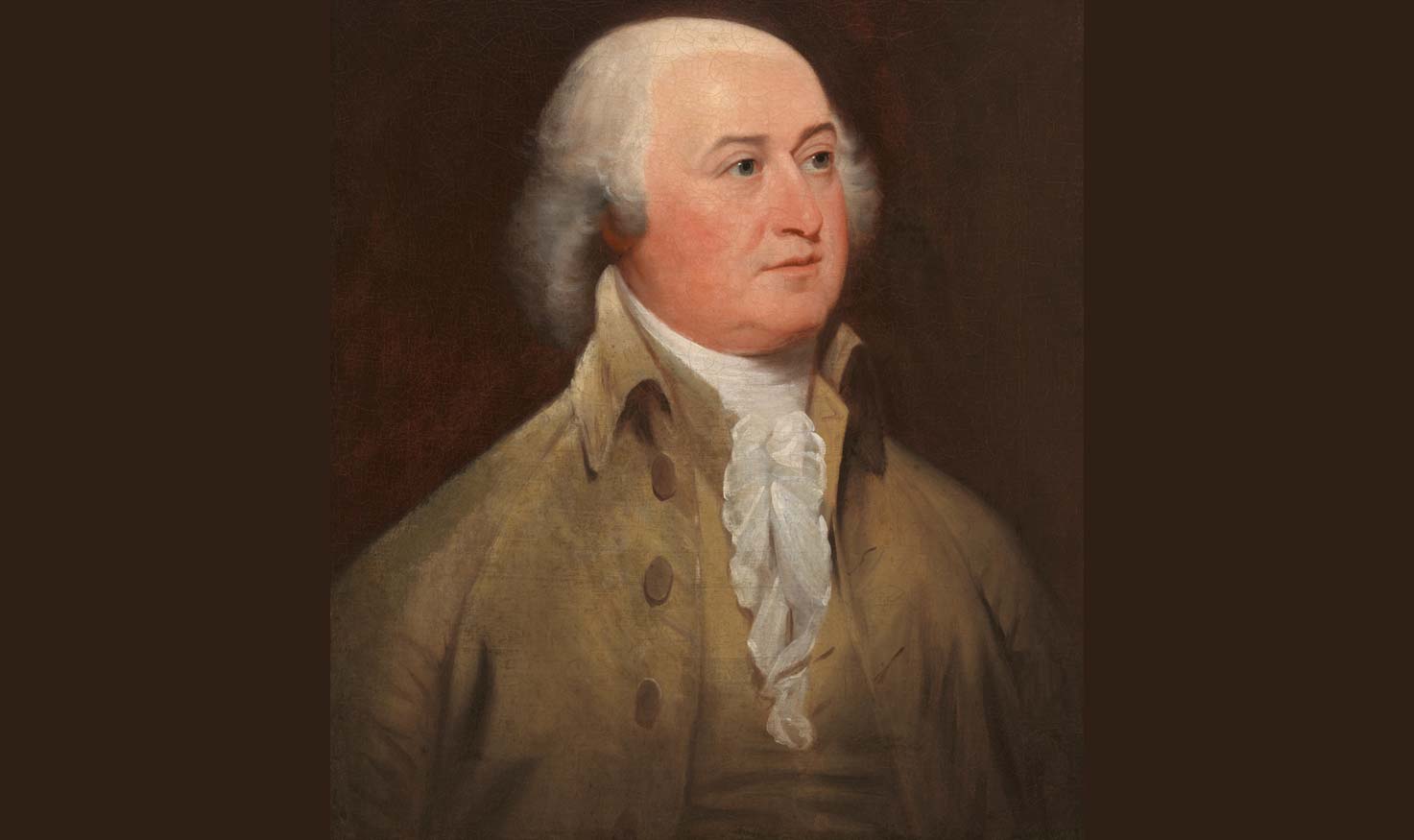
The Sugar Act would ultimately be repealed in 1766 and replaced by the Revenue Act of 1766. But its repeal brought no relief to the colonial resentments toward Parliament. The damage had been done. Years later, John Adams would later write, “I know not why we should blush to confess that molasses was an essential ingredient in American independence.” The Sugar Act led to Increased tensions between the colonies and Great Britain, and it led to the passage of other unpopular taxes, such as the Stamp Act. The Sugar Act is seen as one of the first steps in Britain’s attempt to assert greater control over the colonies, and it helped to create the conditions that led to the American Revolution.
What 5 items were taxed in the Sugar Act?
The Sugar Act taxed sugar, coffee, some wines, pimento, cambric and printed calico. The Sugar Act also regulated lumber exports.
How did the Sugar Act affect colonists?
The Sugar Act made it more difficult for colonists to trade with any nations other than Great Britain. It not only taxed sugar and molasses but put a tax on other critical items of colonial life. The Sugar Act led to feelings of resentment, anger, and the outlook that colonial rights were being infringed upon.
What exactly did the Sugar Act do?
The Sugar Act was an effort by Parliament to raise revenue to help pay debts incurred by the French and Indian War and for garrisoning troops to provide colonial protection. The Sugar Act was also an effort to control colonial smuggling, prop up British interests and businesses, and stricter enforcements of trade and customs policies.
Why was the sugar act passed?
The Sugar Act was passed to raise revenue for Great Britain, to pay for the expense of governing and protecting new colonial territory, and to attempt to stop colonial smuggling.

Sign up to receive special offers, discounts and news on upcoming events.